
The Criollo horse has a long history. Descended from Andalusian horses brought to the continent in the 15th and 16th centuries by Spanish colonists, it adapted to the harsh living conditions encountered there, to whose history it is closely linked.
A working horse, both powerful and docile, lively and calm, it has the unique characteristic of having reverted to a wild state during the chaotic period of the first settlers’ arrival at the mouth of the Rio de la Plata (the site of present-day Buenos Aires) in the 16th century.
During this time, horses proliferated for decades in complete freedom on the surrounding pampas before being tamed again, both by the Pampas Indians and by returning Europeans. The Criollo horse originated in Argentina and then spread to Uruguay and southern Brazil. It was also significantly enriched by horses from Chile, which brought it greater functionality.
The Criollo horse is a daily fixture in the cattle herding tradition on the estancias, as well as in national and international competitions of riendas (maneuvers), paleteadas (a cow driven by two riders), pruebas de aparte, and manguera (cattle sorting in a coral). These events are now grouped into a competition called the Freno de Oro (Golden Bit), which combines morphological and functional evaluation of the Criollo horse as bred in the best Argentinian, Uruguayan, and Brazilian ranches.
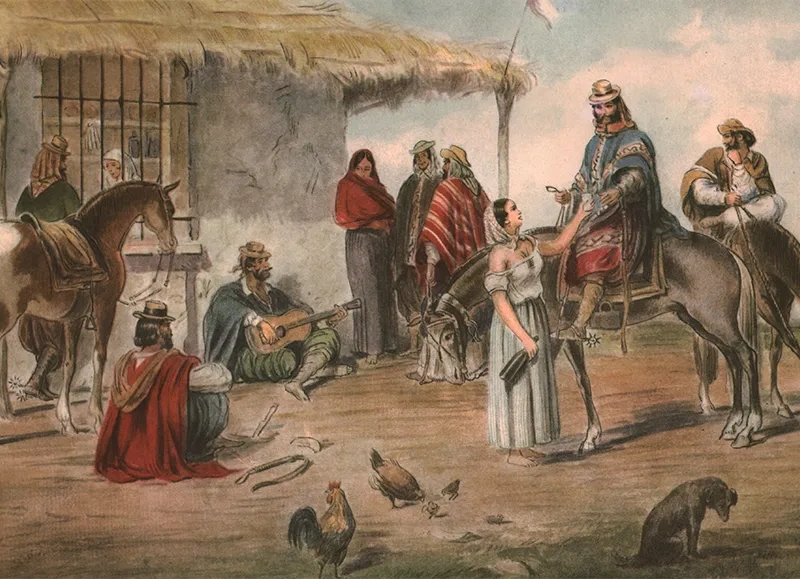
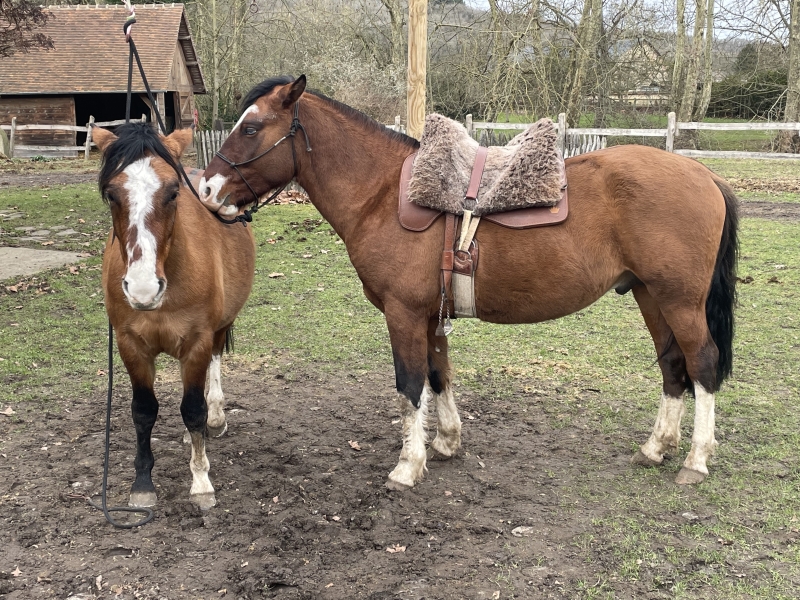
The Criollo horse is intimately linked to its rider, the gaucho, a rugged and independent figure whose image is deeply rooted in South American culture (Argentina, Uruguay, southern Brazil, Chile). The Criollo breed standard (average height 1.44 meters, short and broad head, medium-length neck slightly convex at its topline, muscular and not very prominent withers, short and broad loins, broad and muscular croup and chest…) makes it a harmonious, well-muscled saddle horse with a low center of gravity.
It comes in an infinite variety of coat colors, some of which are very exotic. It also often displays zebra stripes on its legs and a dorsal stripe, characteristics of very ancient breeds.

Do you want to know more, try a criollo horse?
Come visit me!
Contact us : +33 6 72 63 97 26
or
Instragram : criollosdelasrocas